
Zeus
Hybrid carbon-fibre and fibreglass FPV platform that bridges high-speed racing and stabilised camera drones. The rigid CF core keeps manoeuvres precise while impact-resistant fibreglass arms and reinforced motor mounts absorb the hard landings of the training phase. An ArduPilot flight controller gives new pilots a safety net: auto-level Stabilize, GPS Loiter, and one-switch Return-to-Launch with signal-loss and low-battery failsafe. Live telemetry (voltage, GPS, altitude, speed) streams straight into the pilot's goggles.

Published specifications.
All figures subject to operator configuration and deployment profile.
Zeus in the field.
Related platforms.
 In production
Apollo
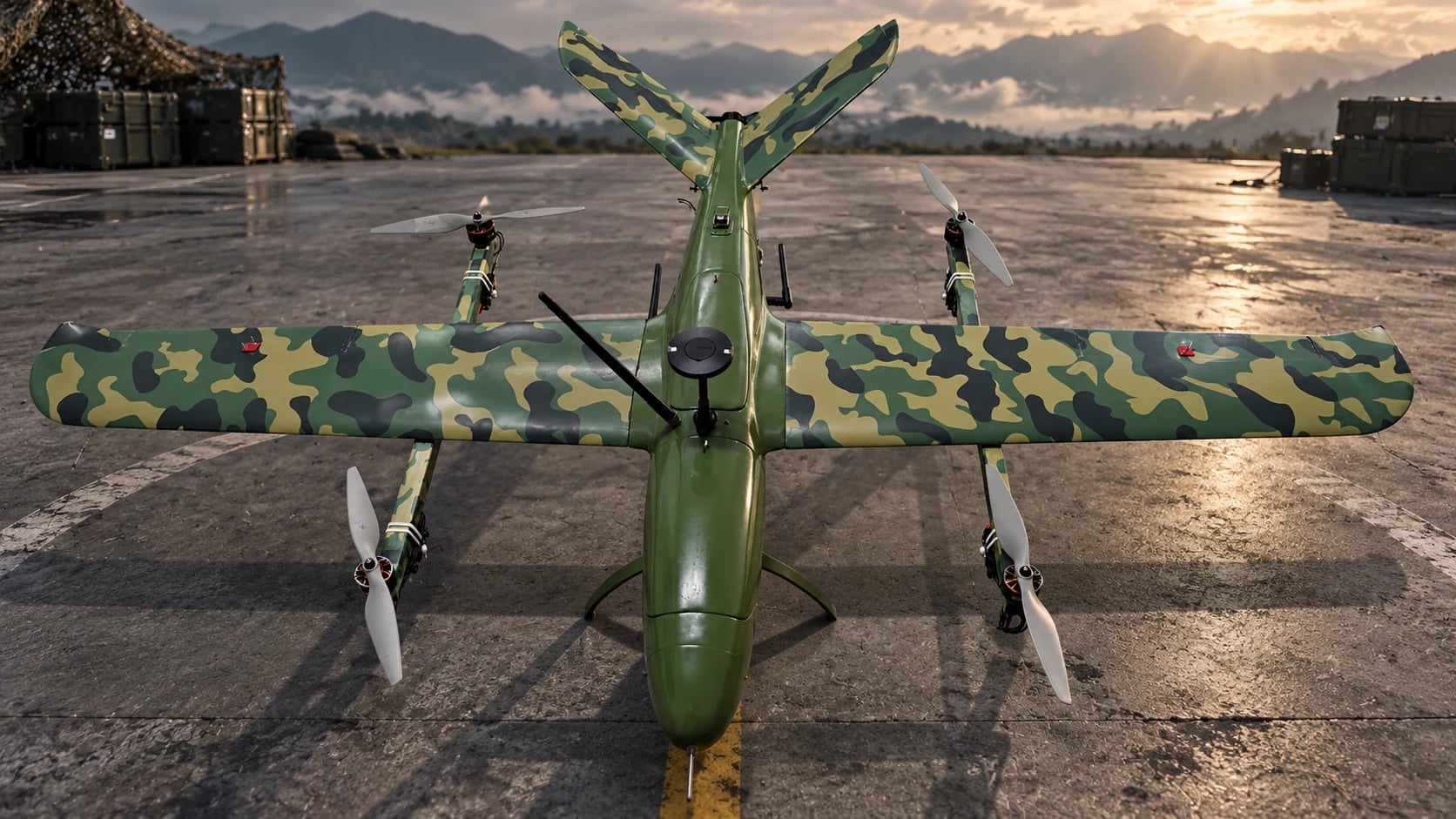
Compact VTOL platform combining vertical launch and recovery with efficient fixed-wing cruise. Apollo carries up to 1 kg, reaches 35–40 km without payload, and integrates a 3-axis stabilized visible/thermal camera with live video and intelligent target tracking.
 In production
Gandiva
Gandiva is a counter-drone system in two parts: a detection layer that uses multi-sensor fusion to spot and track a hostile UAV, and an interceptor layer that deploys drones to bring it down — the whole engagement run from a single Ground Control Unit. Each interceptor is a carbon-fibre 450-class quadcopter, stabilised by an ArduPilot autopilot and fitted with a kinetic tip. It dashes at 90–126 km/h, and 2–10+ can fly together for a layered, sensor-cued intercept.
 In production
Swarm
Swarm is a coordinated team of drones: one 'master' leading any number of others, all built on the 5-inch Zeus quadcopter. They fly as a single formation, covering more ground than a lone UAV while the mission carries on even if a drone drops out. If the master is lost or neutralised, another drone automatically takes over the lead and the rest fall in behind it — so there's no single point of failure. The swarm's intelligence runs onboard each aircraft, coordinating the formation over a long-range radio link, with every drone on a proven ArduPilot autopilot for stable, GPS-guided flight. Automatic return-to-launch and auto-land failsafes bring the drones home safely, and the whole swarm is flown and monitored from a single ground station for tactical, surveillance and autonomy research.