
Gandiva
Gandiva is a counter-drone system in two parts: a detection layer that uses multi-sensor fusion to spot and track a hostile UAV, and an interceptor layer that deploys drones to bring it down — the whole engagement run from a single Ground Control Unit. Each interceptor is a carbon-fibre 450-class quadcopter, stabilised by an ArduPilot autopilot and fitted with a kinetic tip. It dashes at 90–126 km/h, and 2–10+ can fly together for a layered, sensor-cued intercept.

Field it two ways.

A deployable counter-drone unit
Gandiva ships as a self-contained system — detection and interceptors in one package. Set it up on site and it's ready to spot and bring down hostile drones, with minimal operator overhead.
- Detection and interception in one package
- Rapid on-site setup
- Operator-light by design

Simulation as a service
The same system runs as simulation software. Model an operating area, run any number of threat scenarios, and surface the best tactics to neutralise incoming drones — before a single aircraft leaves the ground.
- Model any operating area
- Run unlimited threat scenarios
- Find the optimal counter-drone tactics

Published specifications.
All figures subject to operator configuration and deployment profile.
Gandiva in the field.
Related platforms.
 In production
Swarm
Swarm is a coordinated team of drones: one 'master' leading any number of others, all built on the 5-inch Zeus quadcopter. They fly as a single formation, covering more ground than a lone UAV while the mission carries on even if a drone drops out. If the master is lost or neutralised, another drone automatically takes over the lead and the rest fall in behind it — so there's no single point of failure. The swarm's intelligence runs onboard each aircraft, coordinating the formation over a long-range radio link, with every drone on a proven ArduPilot autopilot for stable, GPS-guided flight. Automatic return-to-launch and auto-land failsafes bring the drones home safely, and the whole swarm is flown and monitored from a single ground station for tactical, surveillance and autonomy research.
 In production
Apollo
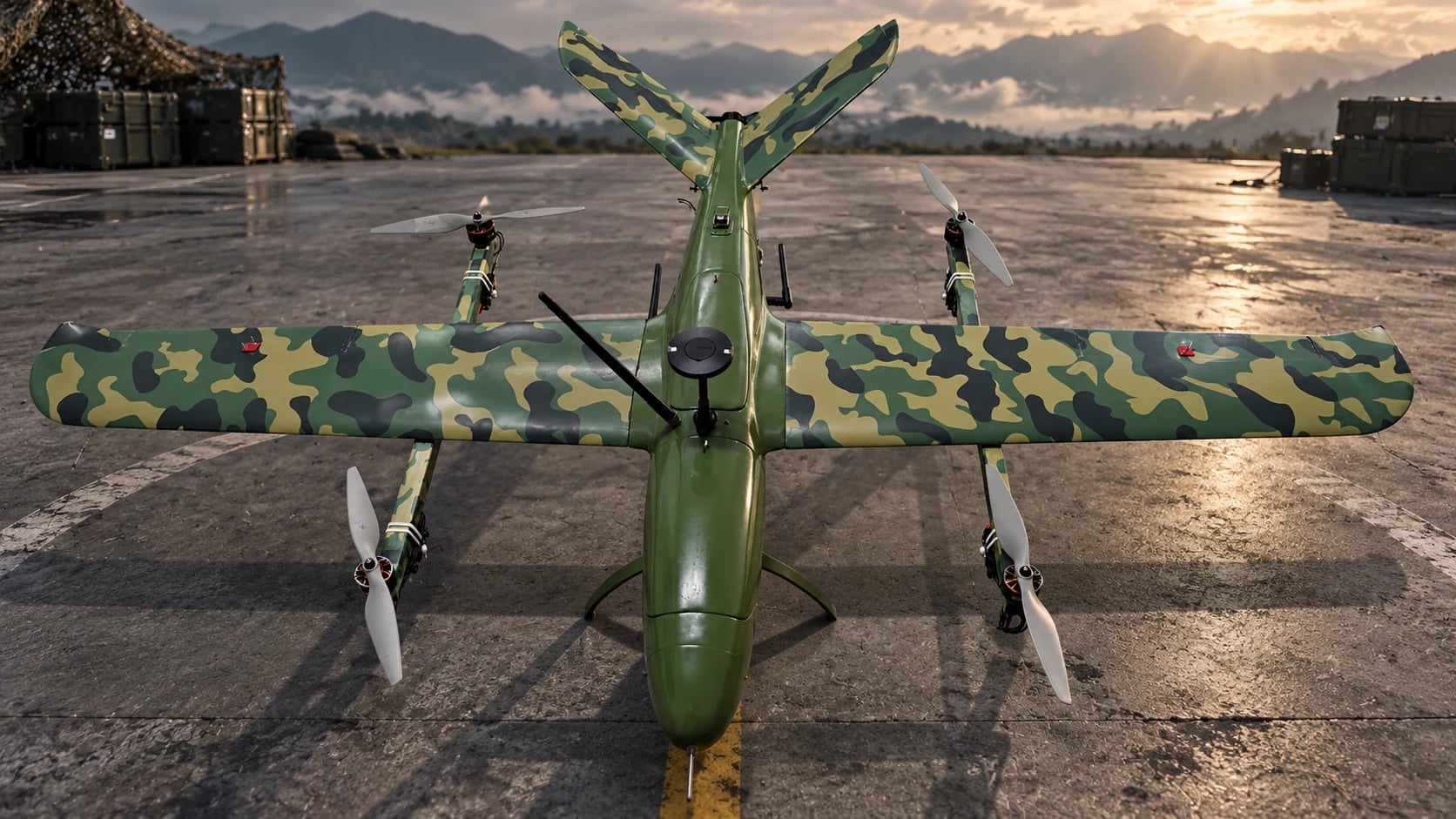
Compact VTOL platform combining vertical launch and recovery with efficient fixed-wing cruise. Apollo carries up to 1 kg, reaches 35–40 km without payload, and integrates a 3-axis stabilized visible/thermal camera with live video and intelligent target tracking.
 In production
Indrajit
10-inch FPV quadcopter with fibre-optic tether for electronic-warfare-resistant command and video. Four range configurations (2 / 5 / 10 / 20 km), 90–100 km/h cruise, analog or digital HD video options. The GCU converts digital signals to optical for jam-proof terminal control.